
Blog Guide
Pleached trees are one of the most useful tools in a Cheshire garden designer’s kit: real privacy and structure at head height and above, without the solid, boxy weight of a full hedge. Here’s what they actually are, which varieties work best, and what looking after them involves once they’re in the ground.
What Pleaching Actually Is
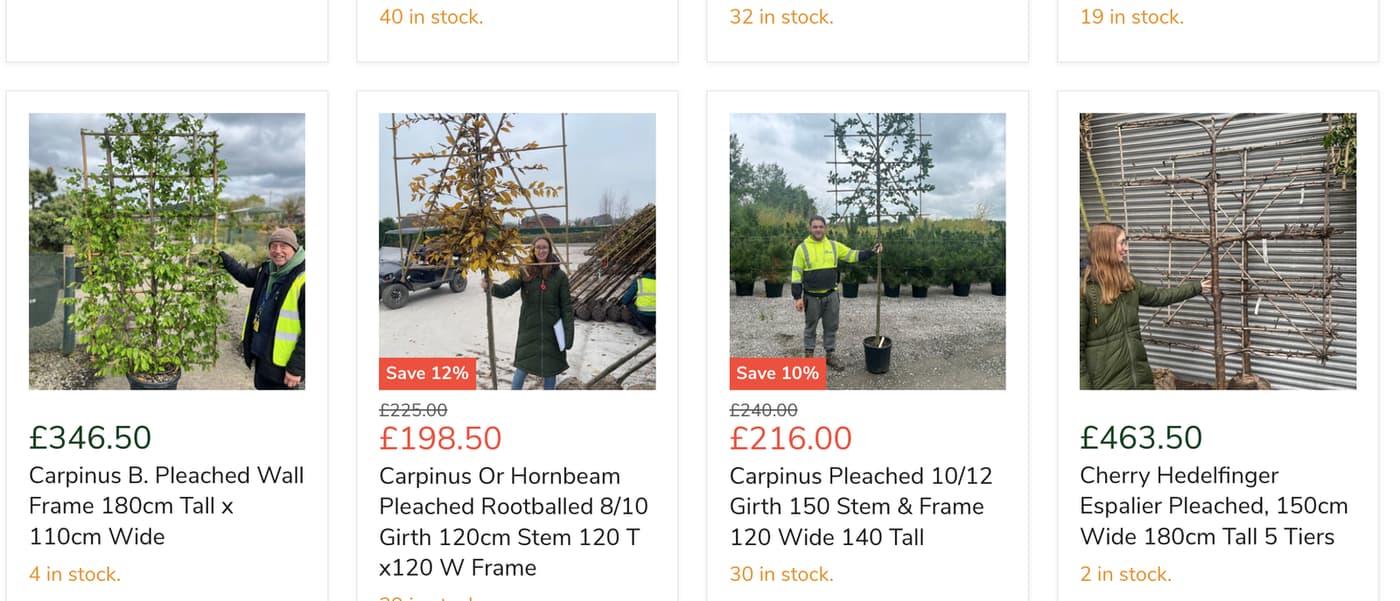
Pleaching is a training technique where a tree’s crown is raised and its branches trained flat, typically on a wire or bamboo frame, to create a tall, open framework topped with a dense, hedge-like layer of foliage. The result reads as a “green wall” on stilts — a screen of leaf at fence-and-first-floor-window height, with clear trunk underneath, rather than a hedge that fills the whole space from ground to top.
That clear trunk is the whole point. A pleached screen gives you privacy exactly where you need it — from a neighbour’s upstairs window, along a boundary, framing a driveway — while keeping the ground level open for planting, paving or simply light. A solid hedge does the same privacy job less precisely and takes up far more ground.
Popular Varieties for Cheshire Gardens
Cherry laurel is a reliable choice for dense, glossy, evergreen screening — a strong, uncomplicated option where year-round privacy matters most.
Elaeagnus offers silvery foliage and fragrant flowers, giving a pleached screen genuine seasonal interest rather than a flat wall of green.
Hornbeam is the classic deciduous choice: vivid green through summer, turning gold in autumn, and — usefully — it holds onto its dried leaves through much of winter, so the screen never goes fully bare.
Ilex (holly) brings rich evergreen foliage and, on female plants, striking red winter berries — a good option where you want structure that also does something decorative through the colder months.
Liquidambar (sweetgum) suits larger gardens with room for its pyramidal form and spectacular star-shaped autumn foliage, thriving in full sun to partial shade on well-drained ground.
Photinia x fraseri is prized for young red growth maturing to glossy green — an evergreen that tolerates a wide range of soil conditions, which makes it a forgiving choice on Cheshire’s variable clay.
Planting and Establishment
Pleached trees typically arrive as semi-mature specimens on a wooden or wire frame, already trained to a flat shape — which means the framework needs to travel and be handled carefully, usually delivered by lorry and unloaded with real care rather than simply tipped off the back. Once in the ground, the frame stays in place for a season or more while roots establish and the tree settles into its new position; removing it too early risks the branches losing their trained shape before it’s properly set.
Cheshire’s clay soil holds moisture well, which generally suits pleached trees, but new plantings still need consistent watering through their first one to two growing seasons while the root system spreads beyond the original root ball.
Ongoing Care
Established pleached trees need trimming once or twice a year to keep the flat plane crisp and stop new growth breaking out of shape — evergreens like laurel and ilex are usually trimmed in late spring and again in late summer, while deciduous varieties like hornbeam are best pruned in winter once they’ve dropped their leaves. Feeding in early spring helps maintain dense, healthy foliage along the trained plane, and it’s worth checking ties and support wires annually as trunks thicken with age.
A Pleached Screen in Practice
Our Yew Tree Farm project used pleached trees as the structural backbone of a walled courtyard garden — giving the space privacy and height without closing in what had been an open, airy plot. It’s a good illustration of what pleaching does best: adding real screening exactly where it’s needed, while keeping the rest of the garden feeling open.
Thinking About Pleached Trees for Your Own Garden?
Pleached trees work best when they’re planned as part of a wider planting and boundary design, rather than added as an isolated feature. Our planting and borders team can advise on the right variety for your soil, aspect and privacy needs — get in touch to talk through your garden.